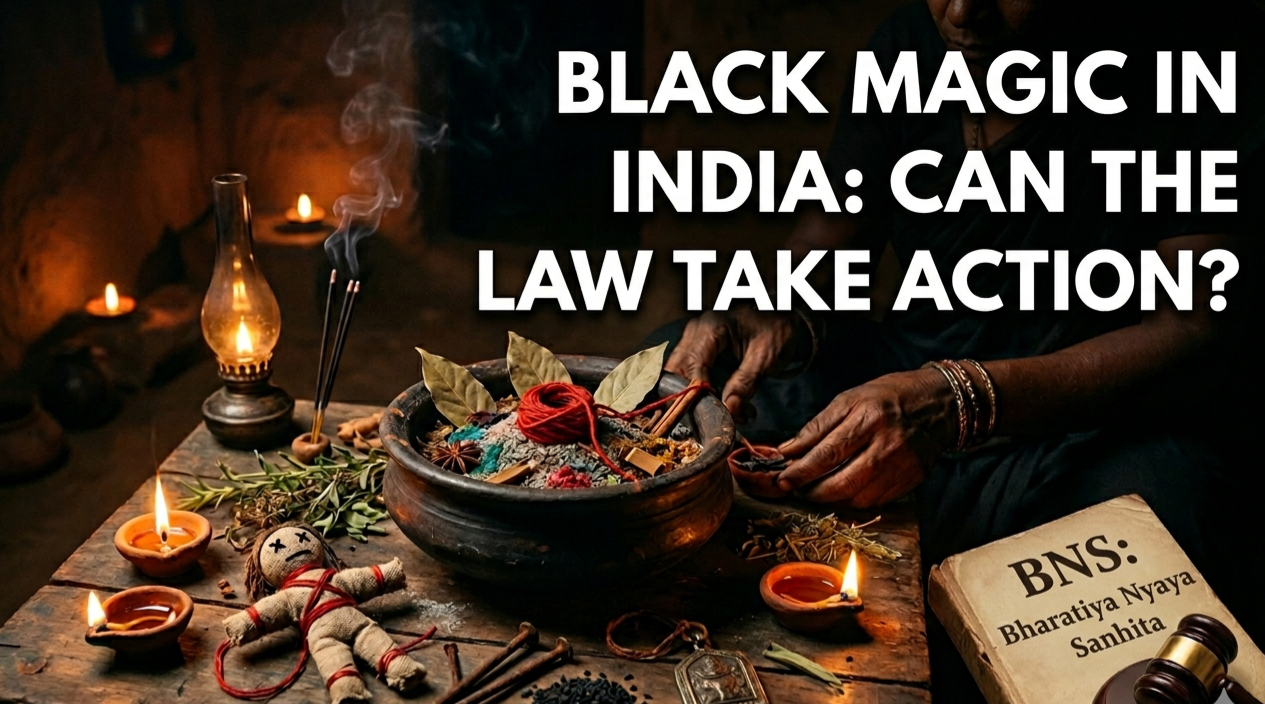
Black Magic in India: Can the Law Take Action Against It?
Black Magic in India: Can the Law Take Action Against It?
In India, superstition, sorcery, and black magic remain highly prevalent in rural areas even today. Incidents involving atrocities against women and children—including witch-hunting and human sacrifice—perpetrated in the name of black magic continue to surface from various states across the country. These incidents inevitably raise a crucial question in the minds of the public: Is there any law in India specifically addressing black magic? Can legal action be taken against those who practice it? And if so, what is the procedure?
In this comprehensive blog post, we will explore the legal processes surrounding black magic in India, the provisions for punishment, and identify which states have enacted strict laws to combat this issue.
What is Black Magic?
Black magic is known by various names—such as Tantra-Mantra*, *Tona-Totka* (sorcery), or *Jhad-Phook* (ritualistic healing/exorcism). It is a practice wherein individuals (often referred to as *Tantrics*) claim to possess and utilize certain alleged supernatural powers to inflict harm upon others. They often attribute a person's illness, mental distress, financial ruin, or even death to the effects of their magic. This constitutes not only a form of psychological abuse but can also escalate into physical violence.
There is no single, overarching central law in India specifically targeting black magic. However, several stringent provisions have been enacted at the state level. Bihar became the first state in India to legislate in this regard in 1999; subsequently, several other states have implemented their own distinct laws for the prevention of superstitious practices. In states where no specific legislation exists, the police can register cases by invoking relevant sections of the Indian Penal Code (IPC)—such as those pertaining to murder, attempted murder, criminal intimidation, and other related offenses.
Status of Black Magic Laws (State-wise)
1. Rajasthan — The Rajasthan Prevention of Witch-Hunting Act, 2015
In Rajasthan, the *Rajasthan Prevention of Witch-Hunting Act, 2015* directly targets the practice of black magic. Under this Act, performing magic with the intent to cause harm to another person is punishable by imprisonment ranging from 1 to 3 years, along with a fine of ₹10,000. Furthermore, if the practice of black magic results in a person's death, the penalty can range from 7 years of imprisonment up to life imprisonment, accompanied by a fine of up to ₹1 lakh. Depending on the severity of the crime, the police may effect an arrest without a warrant.
2. Maharashtra — Black Magic Act, 2013
Maharashtra’s *Prevention and Eradication of Human Sacrifice and other Inhuman, Evil and Aghori Practices and Black Magic Act* was enacted in 2013 and comprises a total of 12 clauses. Under this Act, it is a punishable offense for any individual to earn money by performing so-called miracles; to bind and beat someone with ropes in the name of exorcising spirits; or to engage in inhuman, evil, Aghori, or black magic practices. The Act prescribes a punishment ranging from 6 months to 7 years of imprisonment for such offenses, with a provision for life imprisonment in cases involving human sacrifice. In a 2015 human sacrifice case, three *Tantrics* (occult practitioners) were sentenced to life imprisonment—a verdict that was subsequently upheld by the Bombay High Court.
3. Jharkhand — Prevention of Witch (Dain) Practices Act, 2001
In 2001, Jharkhand enacted *The Prevention of Witch (DAAIN) Practices Act* (Jharkhand Dain Pratha Nivaran Adhiniyam). This legislation was formulated to curb the harassment, physical violence, and murder of women—often after labeling them as "witches" (*Dain*)—within the state's rural and tribal regions. Under this Act, it is a criminal offense to harass someone by branding them a witch, to inflict physical injury upon them, or to claim to provide a "cure" through sorcery, rituals, or faith healing (*Jhad-phook*). The Act prescribes a punishment of 3 months to 1 year of imprisonment along with a fine of ₹1,000–₹2,000 for merely labeling someone a witch; imprisonment of up to 3 years for causing physical injury; and, in cases resulting in death, a sentence of life imprisonment or the death penalty under Section 302 of the Indian Penal Code (IPC).
4. Madhya Pradesh and Chhattisgarh — Anti-Superstition Laws
There is no specific state-level legislation regarding black magic in Madhya Pradesh and Chhattisgarh; however, in the absence of such specific laws, sections of the Indian Penal Code (IPC) are applied in both states. Whenever crimes are committed in the name of witchcraft or sorcery, cases are registered using relevant sections of the IPC—such as Section 302 (Murder), Section 307 (Attempted Murder), Section 323 (Voluntarily Causing Hurt/Assault), Section 508 (Causing Fear/Intimidation), and Section 347 (Wrongful Confinement/Torture).
5. Odisha — Odisha Prevention of Witch-Hunting Act, 2013
In Odisha, the *Odisha Prevention of Witch-Hunting Act, 2013* was enacted to curb the practice of witchcraft and witch-hunting (harassment under the accusation of being a witch) in the state's rural and tribal areas. Under this law, declaring a woman to be a witch, subjecting her to mental or physical torture, damaging her property, humiliating her, or falsely claiming to cure her through ritualistic healing practices (*Jhad-phook*) are all classified as cognizable offenses. Ordinary acts of witch-hunting carry a penalty of imprisonment for up to 3 years and a fine of ₹1,000; however, if the woman is paraded naked or subjected to inhumane humiliation, the punishment ranges from 1 to 5 years of imprisonment along with a fine. Upon a second conviction, the penalty is imprisonment ranging from 3 to 7 years and a fine of ₹10,000.
6. Gujarat — Gujarat Anti-Black Magic Bill, 2024
On August 21, 2024, Gujarat enacted a stringent law aimed at preventing human sacrifice and other inhumane, cruel, and *Aghori* practices, as well as black magic. Under this legislation, various acts have been declared illegal, including human sacrifice (*Narbali*), cruel practices, black magic, animal sacrifice, earning money by performing so-called miracles, physically assaulting or killing someone—often by tying them with ropes—in the name of exorcism or driving out spirits, and engaging in inhumane, malicious, or *Aghori* rituals. It provides for imprisonment ranging from 6 months to 7 years and a fine of ₹5,000 to ₹50,000 for general black magic, while stipulating a sentence of life imprisonment for human sacrifice.
7. Karnataka — The Karnataka Prevention and Eradication of Inhuman Evil Practices and Black Magic Act, 2017
On January 4, 2020, Karnataka formally banned 16 inhuman practices under the Prevention and Eradication of Inhuman Practices and Black Magic Act. Under this law, practices such as black magic, sorcery, human sacrifice, witchcraft (witch-hunting), exorcism (rituals to drive out spirits), parading women naked, animal sacrifice, forcing people to walk on fire, and beating individuals after labeling them as witches have been declared illegal. Under this legislation, a convicted offender faces imprisonment ranging from 1 to 7 years and a fine between ₹5,000 and ₹50,000; furthermore, the law provides for a sentence of life imprisonment or the death penalty in cases where death results from the practice of black magic. Important Note: This law does not interfere with tribal or religious traditions; rather, it specifically prohibits inhuman practices.
8. Assam — 2015 and 2024 Acts
In Assam, the Witch Hunting Act of 2015 and the Aghori Practices Prevention Act of 2024 are two key pieces of legislation enacted to combat black magic and witchcraft-related practices. The first of these—the Assam Witch Hunting (Prohibition, Prevention and Protection) Act, 2015, enacted in 2015—was formulated to prevent the harassment and torture of women accused of being witches. Under this law, declaring someone a witch, subjecting them to physical or mental torture, or attempting to drive them out of their home constitutes a punishable offense. The penalties prescribed under this Act range from imprisonment of 6 months to 7 years, along with a fine of ₹5,000 to ₹50,000. In cases where an individual is murdered after being accused of witchcraft, the punishment may extend to life imprisonment or the death penalty. Secondly, the Assam Evil (Healing) Practices Prohibition Act, 2024—which bans human sacrifice, black magic, and so-called miracles. Under this law, exorcism, faith healing, occult rituals, black magic, and inhumane practices have all been declared illegal. The Act provides for a punishment of 1 to 3 years of imprisonment and a fine of ₹10,000 for general superstitious practices; 3 to 10 years of imprisonment and a fine of ₹50,000 for more serious offenses; and life imprisonment for human sacrifice.
9. Apart from these instances, work is also underway in other states to enact laws against black magic at the state level.
Filing a Case and the Subsequent Step-by-Step Process
If you suspect that someone is practicing black magic, there is no prescribed time limit for taking action; however, any delay may result in the destruction of evidence. Therefore, immediately follow the step-by-step procedure outlined below:
1. File a Complaint: Visit the nearest police station and submit a complaint, either verbally or in writing. Clearly provide a detailed description of the sorcery or occult practice, the name and address of the accused, and the impact it has had on the victim (such as illness, mental distress, financial loss, etc.).
2. Attach Evidence: Submit all available evidence along with the FIR, such as the names and contact numbers of witnesses, video recordings, medical reports (if the illness is linked to the alleged sorcery), pamphlets or advertisements of the *Tantric* (occult practitioner), proof of financial transactions, or any other relevant written documents.
3. Register the FIR: Since this constitutes a cognizable offense, the police have the authority to make an arrest without a warrant. If the police refuse to register the FIR, file a complaint with the Superintendent of Police (SP) or obtain a court order from a Magistrate directing an investigation under Section 156(3) of the CrPC.
4. Investigation Process: Once the FIR is registered, the police will immediately commence an investigation. This process involves interrogating the accused, conducting medical or forensic examinations, and recording and compiling witness statements. The police are required to prepare and submit an investigation report within 60 days.
5. Filing of Charge Sheet in Court: The police file a charge sheet in the Magistrate's Court within 90 days, following which the Magistrate frames the charges and sets a date for the trial.
6. Trial and Hearings: In court, statements are recorded from witnesses, cross-examinations are conducted, and statements are taken from the victim and experts (such as doctors or forensic specialists). The accused is also given an opportunity to present their defense.
7. Verdict and Sentencing: Upon the conclusion of the trial, the court pronounces its verdict. If the crime is proven, the guilty party is sentenced to imprisonment ranging from one year to life imprisonment, along with a fine. In cases resulting in death, the sentence may range from 7 years to life imprisonment.
8. Compensation: The victim receives compensation amounting to up to 60% of the fine imposed. There are special protection provisions in place for women and children.
9. Appeal: If either the accused or the victim is dissatisfied with the verdict, they may file an appeal in the Sessions Court or the High Court.
If the Police Refuse to Register an FIR:
1. Submit a written complaint to the SP (Superintendent of Police).
2. Order from the Magistrate: Under Section 156(3) of the CrPC (Code of Criminal Procedure), one can obtain a court order directing the police to conduct an investigation.
3. File a Writ Petition in the High Court.
4. Contact the SDM (Sub-Divisional Magistrate).
Successful Examples: Notable Cases Related to Black Magic
1. The Nandi Murder Case (Karnataka, 2015)
- Two tantrics (occult practitioners) murdered a woman after branding her a "witch." Subsequently, both were sentenced to death.
Following this incident, the Karnataka Black Magic Act, 2017, was enacted.
2. The Jabalpur 'Tona-Totka' Case (Madhya Pradesh, 2018)
- A tantric ensnared 12 women and extorted money from them. The police subsequently registered an FIR and arrested six individuals.
3. The Rahul Gandhi Pune Black Magic Case (2024)
- A complaint was filed against Rahul Gandhi in Pune under the provisions of the Black Magic Act. The case was registered under the Maharashtra Black Magic Act, 2013.
How to Stay Safe and Aware at the Local Level?
1. Steer Clear of Superstition: For any illness or problem, seek immediate assistance from a doctor or the police; do not approach a Tantric (occult practitioner).
2. Spread Awareness in Rural Areas: Conduct awareness campaigns against superstition at the school, community, and Panchayat (village council) levels.
3. Utilize Police Helplines: In case of any suspicion, immediately call 100 (Police) or 1098 (Child Helpline).
4. Consult a Lawyer: Before initiating any legal action, ensure you consult with an experienced civil or criminal lawyer.
5. Leverage Panchayat and Community Networks: If the police are unresponsive, contact the local Panchayat, social service organizations, or the Mahila Shakti Mission (Women's Empowerment Mission).
6. Special Requirements for Women and Child Safety: In cases involving women and children, immediately contact the Women's Police Station or the Child Welfare Committee. You can make toll-free calls to 1098 (Child Helpline) and 181 (Women's Helpline).
Despite the absence of a central law against black magic in India, strict laws exist in 9 states that empower authorities to punish the guilty. Acts such as Maharashtra's 2013 Act, Rajasthan's 2015 Act, and Jharkhand's 2001 Act are being successfully implemented. "The law protects you, but the evidence must be strong. Therefore, do not tolerate exploitation."
Essential Helpline Numbers:
Police Helpline = 100
Women's Helpline = 181
Child Helpline = 1098
National Human Rights Commission = 011-23385368
This blog is intended solely for the purpose of raising awareness. For legal advice, please consult a qualified lawyer. If you are facing issues related to black magic, contact the police immediately. Do not be afraid—the law is on your side. Share this information with your family, friends, and community. Awareness is the greatest weapon against superstition.
Author: Lawhelp4you.com
> ⚖️ "On the path of truth and justice, the law is your greatest ally. If a crime is being committed, do not remain silent—speak up and seek the assistance of the law."
References and Sources
1. ABP Live — Information on the Black Magic Act
2. TV9 Hindi — The Bill Coming Up in Gujarat
3. Cnews Bharat — Laws Regarding Black Magic
4. Sanskriti IAS — Laws Against Superstition and Black Magic
5. Republic Bharat — Petition Filed in the Supreme Court
6. Lead India — Laws and Penalties Related to Black Magic
7. Drishti IAS — Anti-Superstition Laws
8. IndiaTV — Supreme Court Shocked Over the Stripping of a Woman
9. PIB — NHRC Takes Cognizance of Witchcraft Incidents in Bihar
10. Testbook — The Anti-Superstition and Black Magic Act
11. Juscorpus — Black Magic Laws in India