Difference Between Summons And Warrants
Summons and Warrants: Two Distinct Weapons of the Court that Administer Justice.
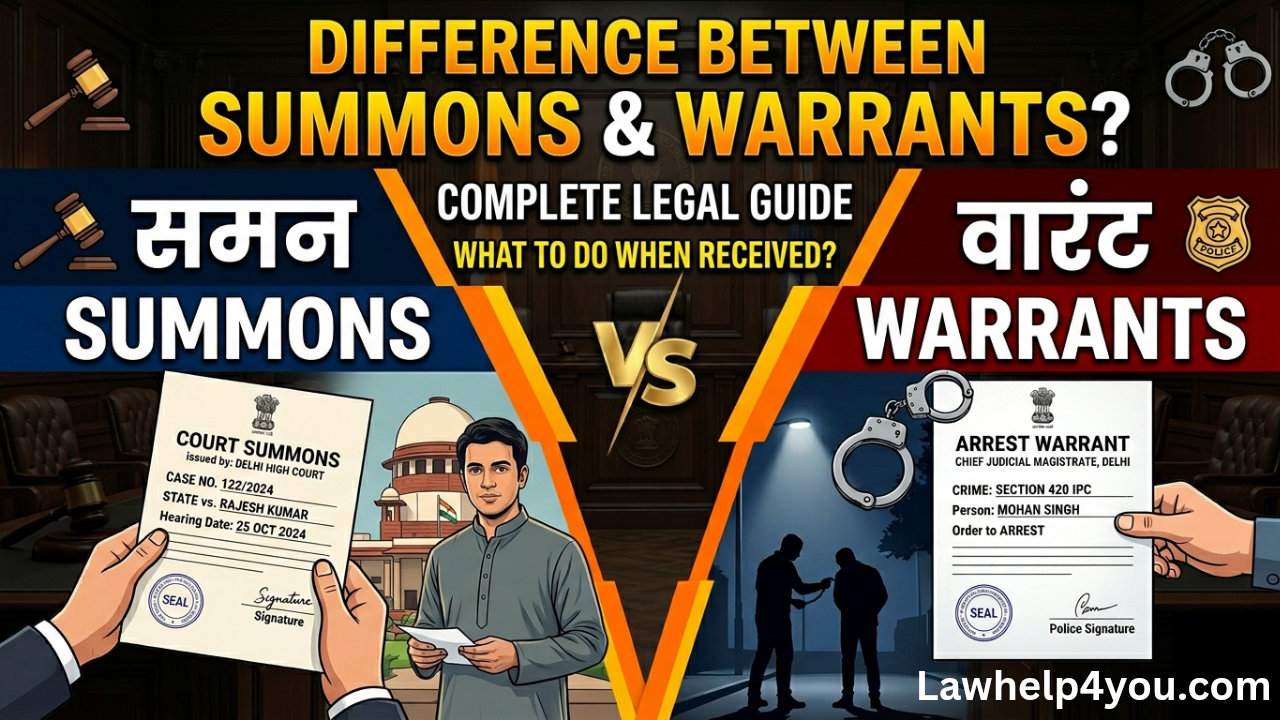
Summons and warrants are legal notices issued by the court that command an accused, witness, or party to appear in court, but their nature, severity, and consequences differ significantly. A summons is a gentle invitation, while a warrant is a strict order to arrest. If you're interested to know about the law, this blog will explore the full differences between summons and warrants.
What is a Summons?
A summons is the court's first step, issued under Sections 61 to 69 of the BNSS. It is a written notice requesting the accused or witness to appear at a specified date, time, and place and to produce documents or testify. Two copies of the summons are made, one of which is given to the accused/witness and the other is kept for record. A summons is signed by a judge, magistrate, or court clerk and served through the police, post, or process server.
Summons are primarily of the following types: witness summons, accused summons, and product summons. Summons are issued for minor offenses like civil disputes (such as rent recovery, check bounce), or in the early stages of an investigation. Don't panic when you receive a summons; it's not a punishment but part of the process. It speeds up the process. Failure to comply with a summons can result in the court issuing an ex-parte judgment, a fine, or an arrest warrant. Failure by a witness to comply with the summons can result in up to six months' imprisonment or a fine of ₹1,000 under Section 208 of the BNSS. Under Sections 61-69 of the BNSS, a summons is a legal order of the court, and ignoring it can be considered obstruction of justice.
What to do when you receive a summons?
1. Accept the summons from the postman and keep a photocopy.
2. Immediately contact to an advocate and provide the case details (plaintiff/defendant name, sections, date) and take advice.
3. Gather necessary documents such as contracts, receipts, emails, etc.
4. Appear at the relevant court with your advocate at the designated time. Hear the charges, and file your response.
What is a Warrant?
A warrant is a binding arrest order issued by a court under Sections 70 to 90 of the BNSS, authorizing the police to arrest the accused and compel his or her appearance at a specified location. It clearly states the accused's name, the crime details, arrest instructions, and the validity period. Only one copy of the warrant is made, and is signed only by the presiding officer (judge/magistrate). It is primarily executed by the police.
There are three main types of warrants:
- Search Warrant (SW): As the name suggests, it is issued by a court to search a place, person, or object suspected of containing evidence of a crime or stolen property. A search warrant issued by a magistrate under Section 96 of the BNSS grants police permission to conduct a search. It is mostly useful for investigation or evidence collection.
- Bailable Warrant (BW): As the name suggests, a bailable warrant allows the police to grant bail after an arrest. A BW is issued in most trademark disputes. An advocate must apply for anticipatory bail upon BW issuance.
- Non-Bailable Warrant (NBW): The police cannot grant bail under a non-bailable warrant. Bail is solely at the discretion of the court. An NBW is issued by the court for serious crimes such as murder. Surrender yourself upon NBW issuance.
Summons and warrants are two wheels of the justice process—one soft and another hard. Take these matters seriously and contact with a advocate. This knowledge could save your business or your family. Lawhelp4you has attempted to provide only basic information about summons and warrants. If you found this information helpful, please share it with your friends.